

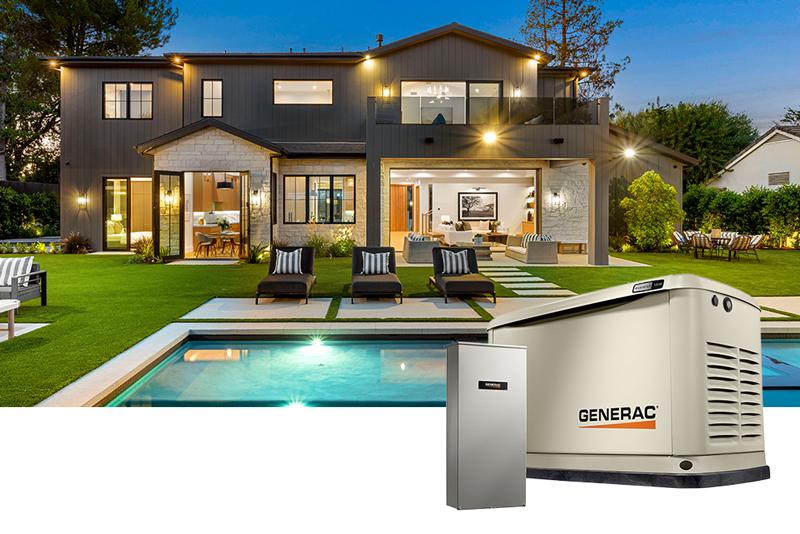
Home Backup Generator Buyer’s Guide: Sizing, Fuel and Real Cost
Power cuts across Europe are getting longer and more frequent — winter storms, grid maintenance, overloaded networks. A home standby generator starts itself within seconds of an outage and runs your house until the grid returns. This guide covers the three decisions that determine the outcome: how big it needs to be, what fuel it should run on, and what it really costs in Europe in 2026 — with real prices, not guesses.
Standby vs Portable: The Question Before the Questions
A portable generator costs a fraction of a standby unit and powers an extension cord. A standby generator is permanently installed, starts automatically in under a minute, runs on your home’s gas supply, and can carry the whole house — including the heating system that keeps pipes from freezing when you’re away. For vacation homes, farms and anyone who travels, the automatic part is the entire point. We compare both honestly in our standby vs portable generator breakdown.
Step 1: Sizing — How Many kW Do You Actually Need?
Oversizing is the most common buying mistake — you pay for capacity you’ll never use, and the engine runs inefficiently at light load. Undersizing means the generator drops the load exactly when you need it.
-
Essentials only (fridge, freezer, boiler, some lights, router): 10–13 kW
-
Most of the house (adds kitchen, well pump, washing machine): 16–20 kW
-
Whole house including electric cooking and multiple heat pumps: 22–26 kW
-
Large estates, three-phase, workshops: 30 kW and up
Air-cooled units cover everything up to about 26 kW; beyond that you enter liquid-cooled territory. Our kW sizing guide for European homes walks through the load-math in detail.
Step 2: Fuel — Gas, LPG or Diesel
-
Natural gas: the cleanest install where a gas connection exists — no fuel storage, no deliveries, effectively unlimited runtime. Output drops slightly on gas versus LPG on some units.
-
LPG (propane): the practical choice across much of rural Europe — a buried or above-ground tank feeds the generator for days. Nearly all residential standby units run on both.
-
Diesel: quieter torque, long runtime from a tank, and the standard for commercial and agricultural standby — see our fuel comparison for the full trade-offs and the commercial generator range for larger applications.
Step 3: What It Really Costs in Europe
Here’s the honest math with current Dutch pricing:
Table
| Component | Typical spend |
|---|---|
| Generator, 13 kW class | from €2,480 (Briggs PowerProtect 13kW) |
| Generator, 20–22 kW class | €2,875–€3,865 (Generac Guardian 22kW · Generac 24kW) |
| Generator + matched ATS bundles | from €2,899–€3,399 (e.g. Generac 22kW with 200A SE transfer switch) |
| Automatic transfer switch, separate | €925–€2,344 (ASCO Series 185 from €925) |
| Installation (estimate) | €1,500–€4,000 depending on gas, electrical and pad work |
Realistic all-in totals, installed: essentials-only system around €4,000–€6,000, whole-house system around €6,000–€9,000, large-property liquid-cooled systems €12,000+. Warranties run 5–7 years on the major residential brands we stock.
Don’t Forget the Transfer Switch
The ATS is the component that makes a standby system “automatic” — it disconnects the grid, starts the generator and transfers the house load in under a minute, then reverses when power returns. Choosing between service-entrance and non-SE models, and 100A versus 200A, trips up most buyers; our automatic transfer switch guide explains the differences in plain language. Bundled generator+ATS kits are usually the cheapest route.
Installation Rules in Europe
Placement, clearances, fuel storage and electrical connection are regulated in every EU country — and they differ. The overview every buyer should read before ordering is in our generator installation guide for Europe.
Common Mistakes
-
Sizing off the main breaker instead of actual loads
-
Buying the generator without the ATS, then discovering the switch costs more than expected
-
Skipping the exercise cycle — modern units self-test weekly; disable it and the first real outage becomes the first real test
-
No maintenance plan — oil, filters and battery matter as much as on a car

Get a Sized Quote
Tell us your home’s essentials list (or your main breaker size and country) — we’ll spec the generator, transfer switch and fuel setup as one delivered quote, shipped from Kessel within 48 hours across Europe. Email info@nhraceengine.nl or request a quote.
FAQ
How much does a whole house generator cost in Europe? Equipment for a 20–24 kW whole-house air-cooled system runs roughly €2,900–€3,900 in our current stock; with installation, most European installs land between €6,000 and €9,000 all-in.
Natural gas or propane: which is better? Whichever you have. Gas is cleaner and needs no storage where a connection exists; LPG suits rural properties without gas lines. Nearly all residential standby units run on both, often with a small output difference.
How long does installation take? Once equipment is on site: typically one to two days for a straightforward residential install, longer if gas lines, concrete pads or permits are involved.
Can a standby generator run for days? Yes — that’s the design intent. Gaseous units run as long as fuel supply lasts (gas grid effectively indefinitely); LPG runtime depends on tank size. Diesel runtimes depend on tank capacity and refilling.
How loud is a home standby generator? Modern residential units run around 60–68 dB(A) under load — conversation-level at typical setback distances — and much quieter in their weekly self-test cycle.
One thought on “Home Backup Generator Guide: Sizing, Fuel & Real Cost | EU”