

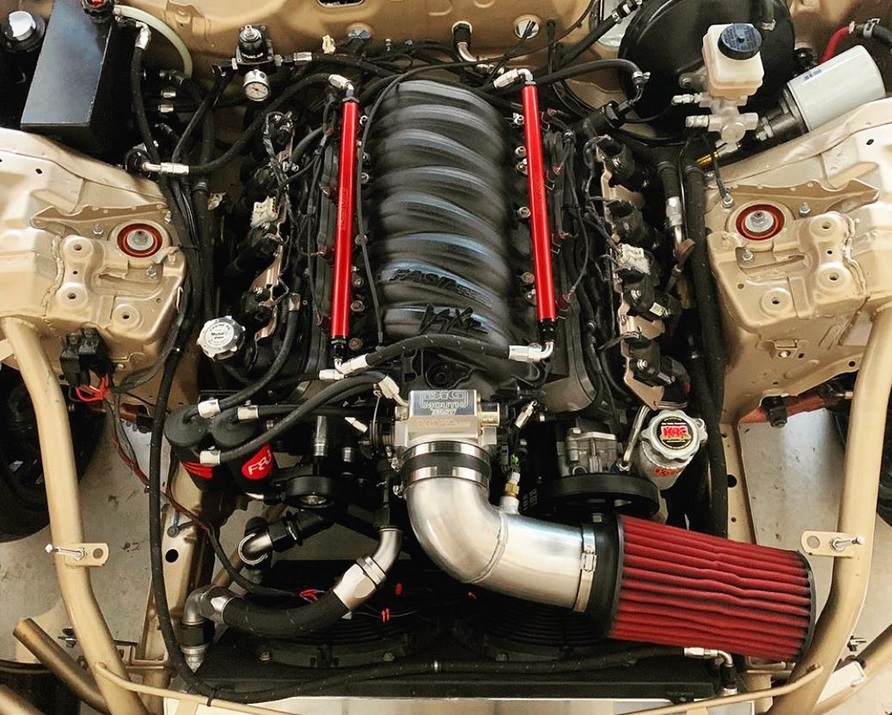
The LS swap has become the default answer to one question: “how do I make my classic genuinely fast without ruining it?” GM’s LS-family V8s deliver modern power, modern reliability and factory engineering to almost any chassis — and at our Kessel workshop we’ve guided dozens of European builders through the process. This guide covers every decision you’ll face, in the order you’ll face it.
Why the LS Became the Universal Swap Engine
Between 1997 and 2020 GM built well over five million LS engines for Corvettes, Camaros, trucks and vans. That volume means parts are cheap, knowledge is deep, and the engine family fits nearly anything: the compact all-aluminum 6.2L weighs about the same as an iron small-block Ford. Add 400–500+ horsepower potential, fuel injection, and a huge aftermarket, and the LS swap earned its reputation honestly.
Choosing Your LS Engine
The first real decision. Here’s how we frame it at the workshop counter:
-
LS1 / LS6 (5.7L) — the budget entry. Light, strong, 350–405 hp depending on variant. Older, higher-mileage donors, but hard to kill.
-
LS2 (6.0L) — the middle ground: more displacement, better heads, still affordable.
-
LS3 (6.2L) — the sweet spot for most builds. 430+ hp stock, the best factory heads, endless support. This is what most of our customers end up with — see our LS Engines collection for crate options that skip the donor hunt entirely.
-
Iron-block 6.0L (LQ4/LQ9) — the torque choice for trucks and boosted builds. Heavy, cheap, nearly indestructible.
-
LSX / aftermarket blocks — only when power goals pass roughly 700 hp.
What Does an LS Swap Actually Cost?
Honest range for a complete European build: €8,000–€25,000, depending mainly on engine choice, transmission and how much you do yourself. The engine is usually only a third of the budget — mounts, wiring, fuel system, cooling, exhaust and transmission upgrades absorb the rest. We break this down line-by-line in our LS swap cost guide for Europe so you can budget before committing.
Motor Mounts, Oil Pans and Headers
Three fitment items decide whether your swap takes a weekend or a month:
-
Motor mounts — adapter plates exist for hundreds of chassis, from ’32 Fords to BMWs. Cheap part, big consequence: get the engine position right first.
-
Oil pan — the stock truck pan rarely fits. Choose a swap-specific pan (Holley, Moroso) matched to your crossmember and steering linkage.
-
Headers — LS exhaust ports sit higher and wider than classic small-blocks. Swap-specific headers clear steering and frame rails; universal ones usually don’t.
Wiring and ECU: The Part People Fear Most
It looks intimidating; it’s actually one of the easier pieces now. Your options, simplest to most involved:
-
Standalone harness + factory ECU — a reworked OEM harness with VATS delete. The most common route; plug in and run.
-
Aftermarket EFI systems (Holley Terminator X, FiTech) — self-tuning, clean install, designed for swaps.
-
Full custom harness — for builds where the engine bay must look factory.
Fuel, Cooling and Exhaust
The LS needs 58+ psi of fuel pressure — your classic’s 5 psi mechanical pump won’t work. Plan for an in-tank or inline electric pump with proper filtration. Cooling needs a radiator sized for the actual heat load (aluminum, three-row minimum for most V8 builds), and a thermostat-controlled fan. On exhaust: 1¾”–1⅞” primaries for most street builds; don’t strangle a 500 hp engine with 1⅝” pipes.
Transmission Options
The LS bellhousing pattern differs from classic Chevy transmissions, so this decision arrives early:
-
Automatic — 4L60E (up to ~450 lb-ft), 4L80E (the safe choice for big power), or modern 6/8/10-speeds with a standalone controller.
-
Manual — T56/T56 Magnum for the classic feel, TKX for modern overdrive strength.
-
Adapters — let you keep your original gearbox; fine for cruisers, questionable for power.
Whichever route: match the converter stall and clutch to your cam, or the drivetrain will feel wrong no matter how good the engine is. Our transmission rebuilds team can spec and build the box to match.
The Mistakes We See Most
-
Underestimating the fuel system — fuel starvation kills more fresh LS swaps than any mechanical failure.
-
Wrong stall speed — a big cam with a stock converter feels like a broken engine.
-
Skipping the dyno — a day on the dyno finds lean spots and timing issues before they find your pistons.
-
Cheaping out on the cooling system — LS engines run hot in tight engine bays; margin is not optional.
Ready to Start Your LS Swap?
Tell us your chassis, your power goal and your country — we’ll recommend an engine and spec the supporting parts honestly. Email info@nhraceengine.nl or request a quote. Engines ship from Kessel within 48 hours, delivered across Europe in 3–7 days.

FAQ
How hard is an LS swap for a first-timer? Mechanically it’s straightforward — adapter mounts and swap-specific parts exist for most chassis. The wiring and fuel system are where novices struggle, so budget for a standalone harness and electric fuel delivery from day one.
Can I keep my original transmission? Often, yes, with an adapter plate — but only if it can handle the torque. A 60-year-old three-speed behind a 500 hp LS is a grenade with the pin half-pulled.
Is a carbureted LS easier than EFI? Simpler wiring, yes — options like the Chevrolet Performance LS376/515 swap EFI for a carb. You trade cold-start manners and fuel economy for simplicity. For daily drivers we usually recommend EFI.
What tools do I need? Beyond standard hand tools: engine hoist and leveler, torque wrench, wiring tools, and patience. A lift transforms the job but isn’t mandatory.
How long does an LS swap take? A well-prepared weekend warrior with all parts on the shelf: 40–80 hours. Real-world with parts hunting and surprises: most builds take two to six months. Buy everything before you start.