

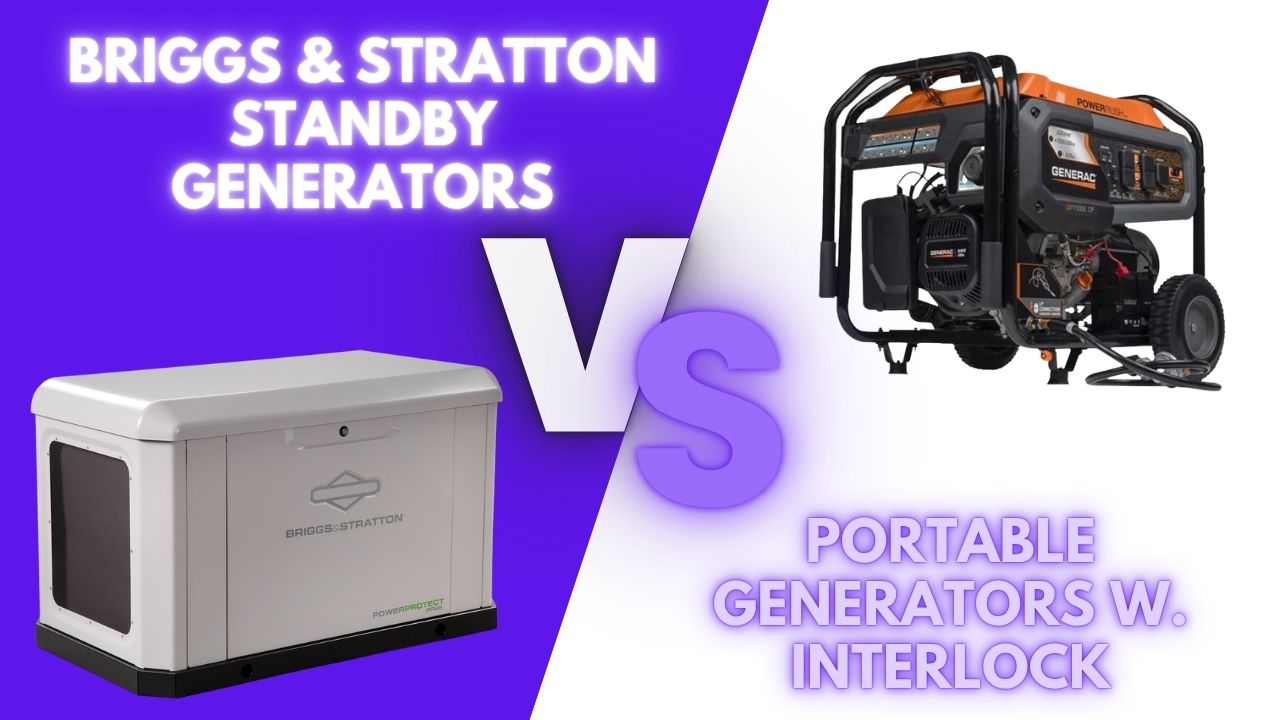
Standby vs Portable Generators: An Honest Comparison

Most “standby vs portable” articles online are written by retailers who only sell one of them. We sell neither bias — we sell standby units, but the honest answer is that portable generators are the right choice for a large share of buyers, and the wrong choice for a different large share. Here’s how to know which group you’re in.
If you’re earlier in the process, our home backup generator buyer’s guide covers sizing, fuel and total cost — this post is the fork in the road that comes before all of that.
How They Actually Differ
Table
| Portable | Standby | |
|---|---|---|
| Purchase price | €400–€1,500 | from €2,480 installed-unit (13kW Briggs) |
| Startup | Manual, in the rain, possibly at 2 a.m. | Automatic, under 60 seconds, even when you’re away |
| Capacity | 2–8 kW typical | 13–26 kW residential, far beyond |
| Fuel | Petrol, stored in jerry cans | Natural gas or LPG, plumbed in |
| Runtime | 8–12 hours per fill | Effectively unlimited on gas |
| Installation | Extension cords | Fixed install + transfer switch |
| Noise | 65–75 dB(A) under load | ~60–68 dB(A), quiet weekly self-test |
| Whole-house heat pump / well pump | No | Yes, if sized correctly |
Where Portable Generators Win
-
Your outages are rare and short — a few hours a year, not days.
-
Budget is the binding constraint — a €600 portable plus an inlet box covers essentials for under €1,000.
-
You need power elsewhere — camping, market stalls, job sites. A standby unit never leaves home.
-
You rent or plan to move — portables travel; standby units are part of the building.
-
Choose an inverter model for sensitive electronics — clean power, quieter running, and far better fuel economy at light load.
Where Standby Generators Win
-
You leave home. Winter outage while you’re abroad for a week is the single strongest argument — frozen pipes don’t wait for your return.
-
Heating matters. A portable won’t run your boiler or heat pump. A properly sized standby keeps the house warm indefinitely.
-
Fuel logistics. Petrol goes stale, storage is limited and refueling a hot generator in a storm is genuinely unpleasant. Gas and LPG arrive by pipe or tank.
-
Safety. Standby systems transfer power automatically and legally. Portable backfeeding through a window lead kills utility workers every year — and a proper transfer switch removes the temptation.
-
Load size. Fridge, freezer, boiler, pumps, kitchen, office — past about 6 kW of essentials, portables run out of road.
The Hidden Costs of the “Cheap” Option
A €600 portable rarely stays €600: fuel stockpiling, stabilizer, oil changes every 50–100 hours, a weather cover, maybe an electrician-installed inlet and manual transfer switch (€300–€800), and eventually the inverter upgrade when the noise wears the household down. Over ten years of regular use, the honest total-cost gap narrows considerably — and a standby unit adds resale value to the property, which a portable never will.
The Decision in Three Questions
-
How often and how long do you lose power? Rare/blinking → portable. Multi-day events → standby.
-
Must it work when nobody’s home? Yes → standby, automatically. Only when you’re there → portable is viable.
-
What’s on the must-run list? Essentials under ~6 kW → portable with a proper inlet. Heating, pumps, workshop → size properly with our kW sizing guide and go standby.
Get an Honest Recommendation
Tell us your outage history, location and must-run list — if a portable genuinely suits you, we’ll say so. If standby is the answer, we’ll size and quote it as one delivered package, shipped from Kessel in 48 hours. Email info@nhraceengine.nl or request a quote.
FAQ
Should I buy a standby or portable generator? If outages are rare, short and you’re always home — portable wins on value. If outages last days, you travel, or heating must never stop — standby wins, and it isn’t close.
Can a portable generator power a whole house? Not realistically. Whole-house loads start around 15 kW; portables top out around 8–10 kW at continuous rating. Essentials-only is the honest portable ceiling.
Do I need a transfer switch for a portable generator? If you want to power hardwired circuits (boiler, well pump, fixed lights), yes — an inlet and manual transfer switch, installed by an electrician. Extension cords to free-standing appliances are the only cord-only safe option.
Are standby generators loud? Modern residential units run about 60–68 dB(A) under load — roughly conversation volume at the property boundary — and far quieter in their automatic weekly self-test.
What about inverter portable generators? They’re the best portable choice for electronics and noise, at roughly double the price of a conventional open-frame unit. For occasional outage duty, they’re worth it; for whole-house goals, they’re still a portable.